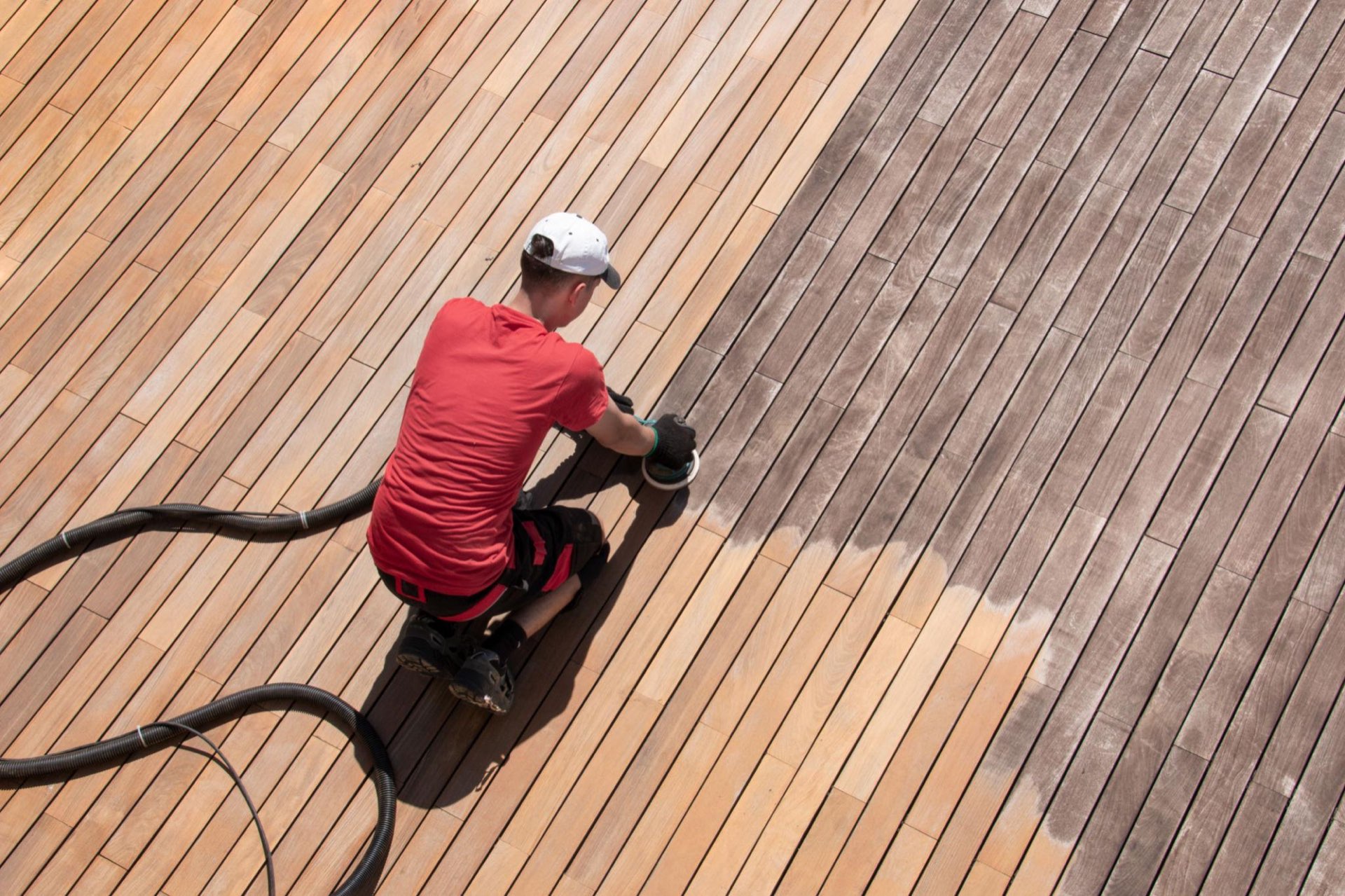
Ipe Deck Restoration in Venice
Between the Venice canals, walk-street bungalows, and rooftop decks a few blocks from the sand, this neighborhood puts Ipe decking through a uniquely intense combination of salt air, blown sand, and full coastal sun.
The premier Ipe refinishing crew in Venice, Los Angeles County.
Venice is unlike most Southern California coastal towns in how tightly packed its exposure factors are. Homes along the canals deal with still, humid air and algae growth on shaded dock and deck surfaces. Walk-street homes just blocks from the boardwalk take on windblown sand that acts almost like light abrasion against deck boards over time. And rooftop decks, increasingly common on Venice's narrow infill homes, sit in full, unshaded sun most of the year. Ipe is a strong material choice for all three conditions, but each needs a slightly different restoration approach.
Venice's canal homes often have small private docks or canal-side decks that rarely get direct sun for long stretches, encouraging algae and soft graying rather than dry cracking. A few blocks over, walk-street properties near the boardwalk deal with fine sand working into deck seams, while newer rooftop decks on rebuilt Venice homes face constant, unbroken sun exposure above the surrounding rooftops.
We're the same veteran-owned crew behind Venice teak restoration and outdoor furniture refinishing. Browse recent projects in our project gallery or request a free estimate for your Venice Ipe deck.
Serving Venice landmarks & communities
- Venice Canals
- Venice Beach Boardwalk
- Abbot Kinney Boulevard
- Marina Peninsula
- Windward Circle
- Venice Canals
- Silver Strand
- Marina Peninsula
- Abbot Kinney
- Oakwood
- Milwood
Why Venice's Sand, Salt, and Sun Combination Ages Ipe Fast
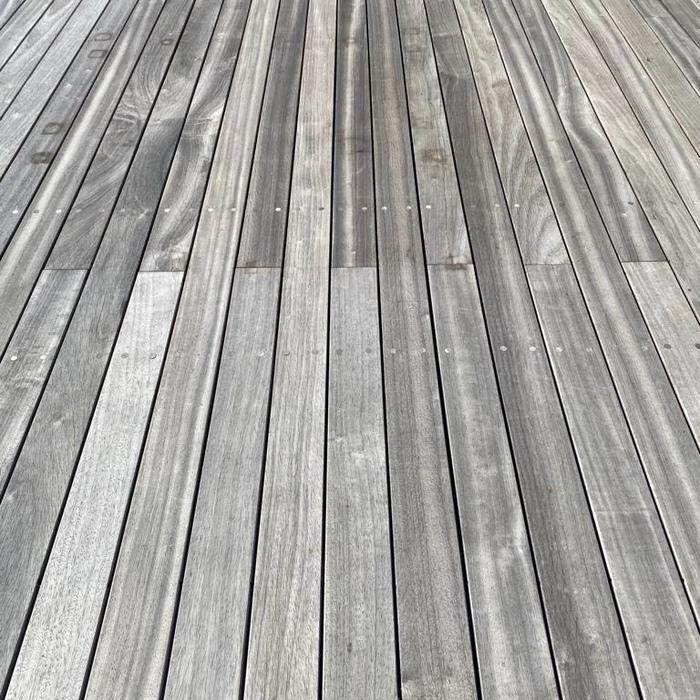
Blown beach sand acts as a mild abrasive on walk-street decks, wearing at the finish and exposing fresh wood fibers that gray more quickly once uncovered. Add in salt spray carried inland from the boardwalk and marina, and the surface oxidizes and dries out faster than in more sheltered neighborhoods. Canal-side decks face the opposite problem: shaded, still air that holds moisture and encourages algae and mildew rather than dry graying.
Benefits of Restoring Ipe in Venice's Mixed Conditions
Because Venice properties can face sand abrasion, salt exposure, or shaded dampness depending on location, we assess each deck individually rather than applying a one-size approach. Sanding removes sand-worn and salt-oxidized surface layers, while the right oil formulation protects against whichever condition dominates, whether that's UV and salt on a rooftop or moisture and algae on a canal dock.
It reads as intentional
Silvered Ipe looks neglected next to modern glass and stone. A finished deck ties the whole elevation together.
It photographs
Listing and rental photography in Venice lives or dies on the outdoor space. A refinished deck changes the first frame.
It protects the substructure
Water that stops at the surface never reaches joists, hangers and fasteners underneath.
It is safer underfoot
Splintering, raised grain and lifted fasteners all get resolved as part of the same visit.
The Ipe surfaces we are asked about most
The craft is the same across all of them; access and detailing are what change the day.
Main deck field
Machine work, straightforward, and where most of the square footage sits.
Stairs and treads
Hand work, safety-critical, and the highest-wear element on any deck.
Fascia and skirting
Vertical, highly visible, and usually more weathered at the bottom than the top.
Rail caps and posts
Constant hand contact, so the finish choice here is about feel as much as looks.
Docks and gangways
Permanently damp and slip-critical. Product selection is driven by traction, not colour.
From gray boards to a finished deck.
Estimate visit
Free, on-site, usually thirty minutes. You get square footage, condition notes and a fixed written price — no surprises later.
Protect the site
Glass, stone, planting, pool coping and cable rail all get masked. Dust containment matters as much on a deck as it does indoors.
Wash and dwell
A dedicated hardwood cleaner is left to work rather than blasted off. Pressure washing shreds Ipe's soft early wood and we do not use it.
Sand flat and true
We chase out the fuzz, the checking and the traffic lanes until the surface is uniform under raking light.
Finish and detail
Oil on the field boards, hand-worked into fascia, stair risers and rail caps where the eye lands first.
Walk it with you
We hand the deck back in daylight, point out anything worth watching, and book the maintenance coat if you want one.
Ipe Deck Care in Venice
Canal-side decks benefit from periodic scrubbing to remove algae before it stains the wood, paired with oiling roughly every 12 months since shade slows UV-driven graying but not moisture damage.
Walk-street and boardwalk-adjacent decks should be swept regularly to reduce sand buildup in board gaps, and we typically recommend oiling every 9 to 12 months given the combined sand and salt exposure.
Rooftop decks on rebuilt Venice homes, fully exposed to sun and wind, usually need the shortest interval of the three, closer to 9 months, to prevent surface checking.
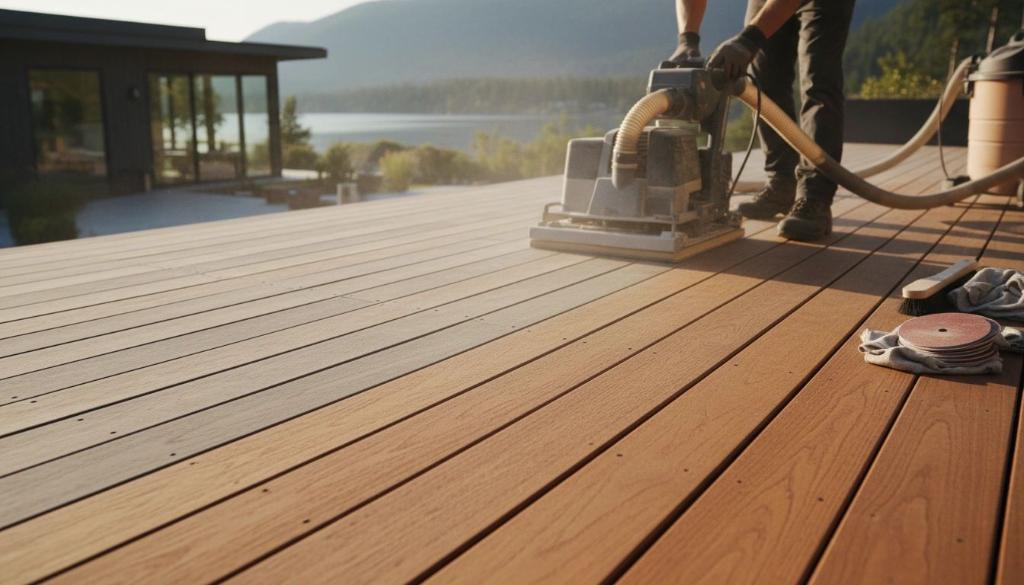
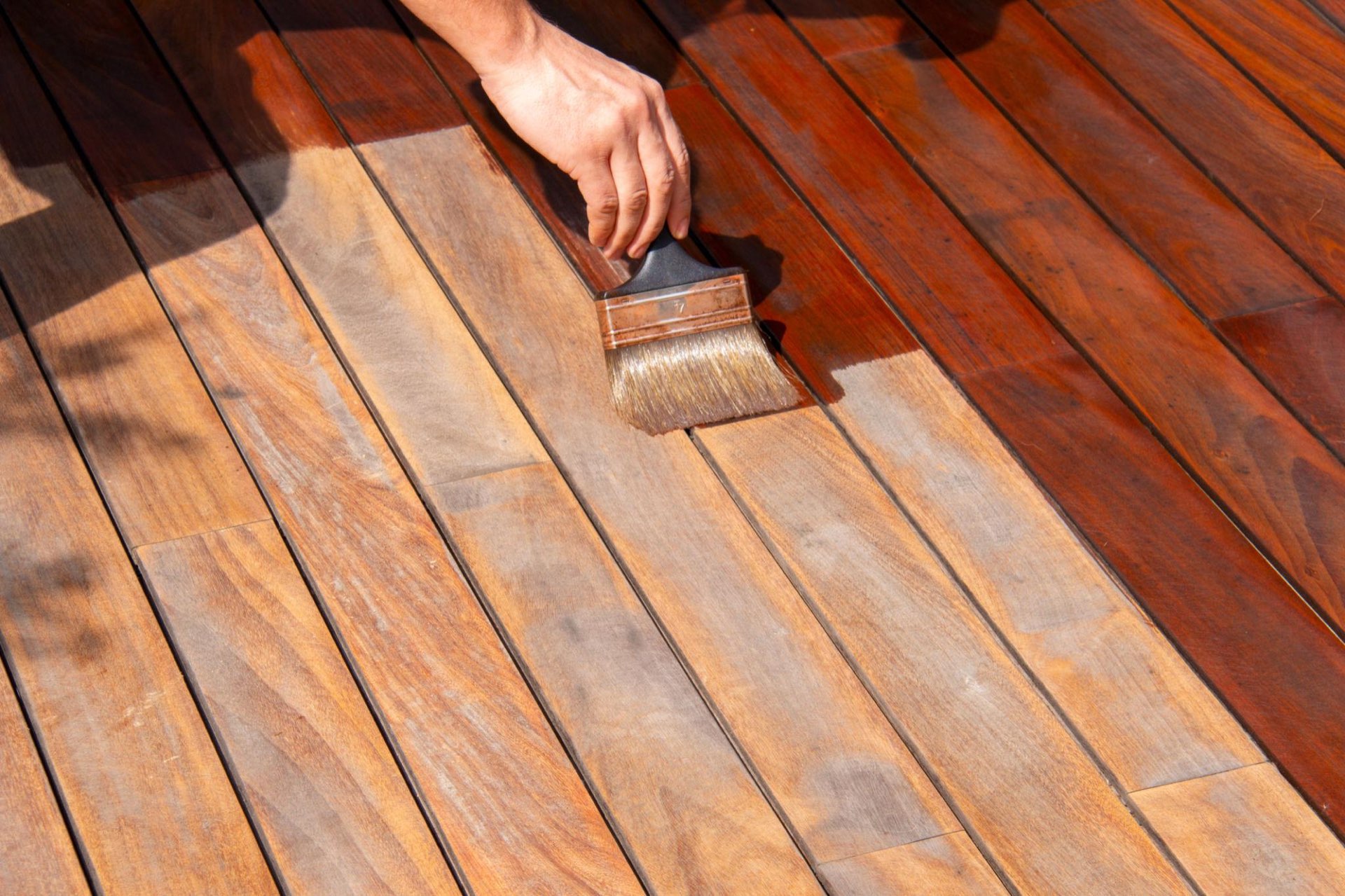
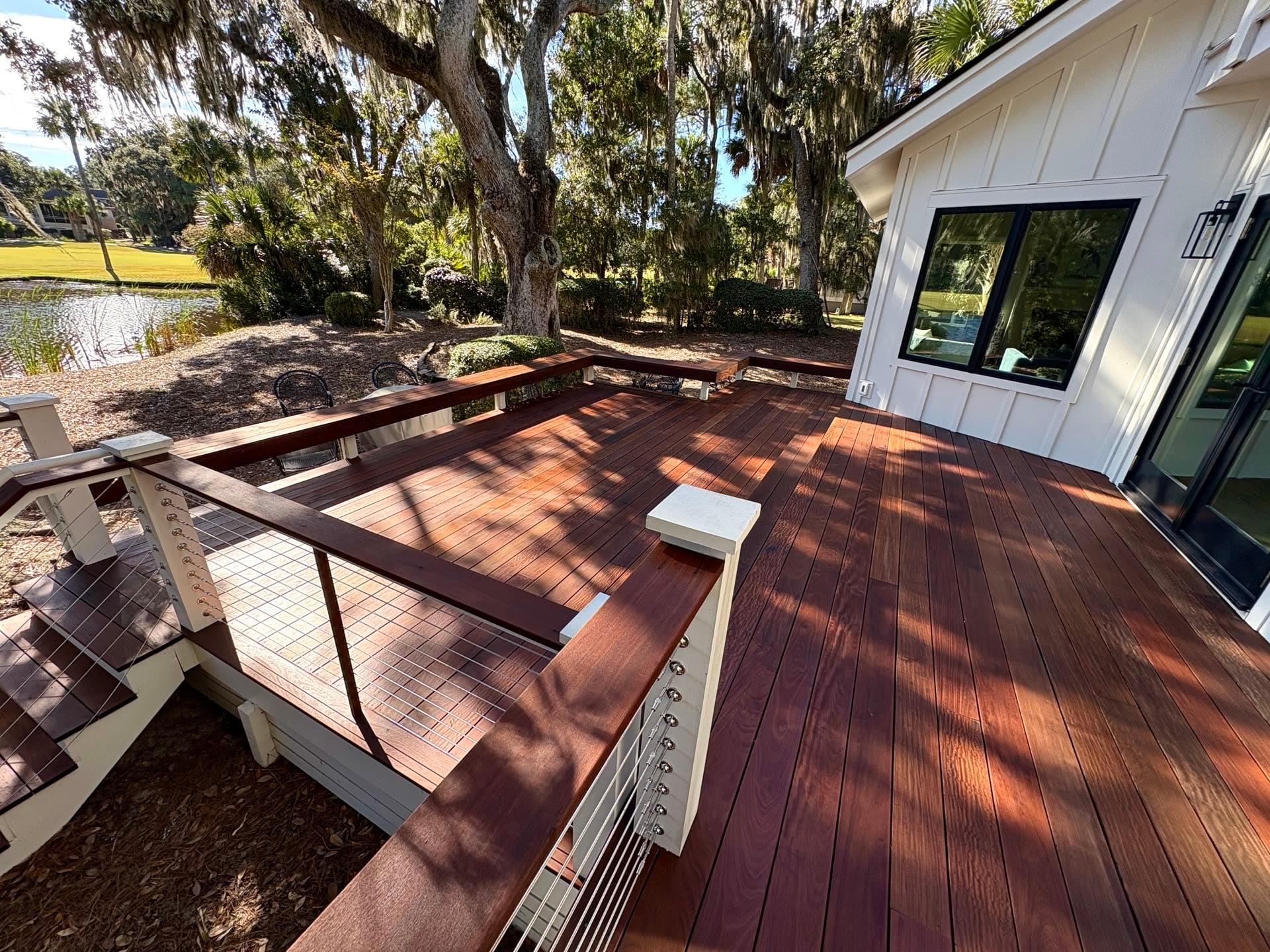
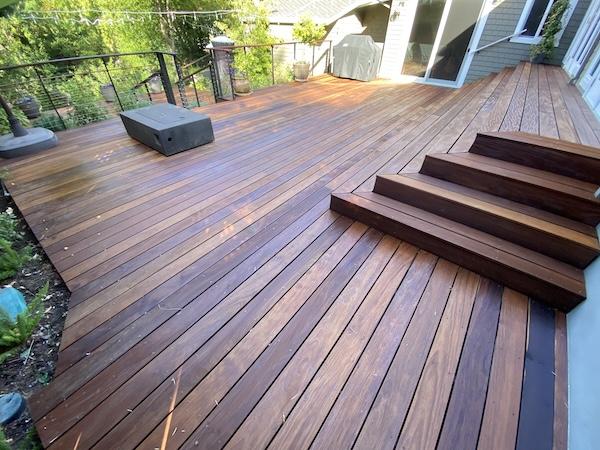
The same boards, a few days apart.
Nothing here was replaced. Each of these decks is the original Ipe, cleaned, abraded flat and re-oiled in place. See more on our full project gallery.
The five-minute monthly deck check
Walk the deck once a month and look for five things. Anything you catch here is cheap to fix; anything you miss gets expensive.
Beading
Flick water at three spots: the sunniest board, a traffic lane and a sheltered corner. Note where it stops beading first.
Fasteners
Any screw head standing proud of the surface is a splinter and a stain waiting to happen.
Edges and end grain
Board ends drink water. They are always the first place a finish gives up.
Under things
Lift a planter and a lounger. Damp, dark patches mean the deck is not drying underneath.
Colour drift
Compare an exposed board with a sheltered one. The gap tells you how far the finish has moved.
Ipe deck refinishing in Venice.
Ipe deck refinishing near Venice
If you are comparing quotes across the area, these nearby Venice service pages cover the same work in neighbouring towns.
Worth reading before you book
When Does an Ipe Deck Need Refinishing?
Colour loss alone is not a reason to refinish. These are the signals that are.
Read guideSanding vs. Stripping Exterior Wood
Both are preparation methods with different jobs. Choosing wrong either wastes wood or leaves contamination behind.
Read guideHow to Restore Weathered Teak Furniture
Grey teak is almost always surface oxidation, not damage. Here is the full sequence used to bring it back, and the points where the job usually goes wrong.
Read guideReady to bring your Venice Ipe deck back to life?
Free on-site estimates. Most quotes returned within 24 hours.
Get a written quote for your Venice deck.
Square footage, condition notes and a fixed price — sent in writing, usually the day after we visit.