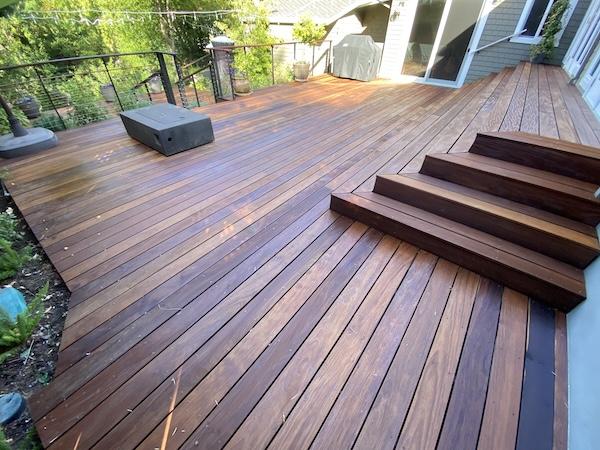
Ipe deck refinishing for dense tropical hardwood
Ipe is hard enough to blunt tools and dense enough to reject most coatings. Refinishing it well is a preparation problem, not a product problem.
Ipe earned its reputation because it barely reacts to weather. It is dense, tight-grained and naturally resistant to rot and insects, which is why decks built from it outlast the finishes applied to them several times over.
That density is also what makes refinishing different. Ipe absorbs very little product, so heavy applications sit on the surface, stay tacky in the heat and collect dust. The work that decides the result is sanding: levelling the boards, opening the grain just enough, and getting the surface clean and dry before anything is applied.
We refinish ipe and comparable hardwood decking on site, including board repairs and fastener work where sections have moved, cupped or split at the ends.
Condition
What a tired ipe deck looks like
Some of these are cosmetic and some mean the surface has stopped protecting itself. It is worth separating the two before spending anything.
Silvered boards
Uniform grey from UV breaking down surface fibres. Reversible, and harmless if you like the look.
Water soaking in
The clearest signal that the finish is spent and the boards are absorbing whatever lands on them.
Rough or splintering traffic areas
Raised fibres where footfall and weather have eroded the surface. Sanding resolves it.
Black spotting
Mildew holding in a bare, damp surface, usually where drainage or airflow is restricted.
End checking
Fine splits at board ends where moisture cycles fastest. Normal, and slowed by sealing.
Peeling coating
Almost always a film finish that could not key into the dense grain. It has to come off completely.
Process
What refinishing an ipe deck involves
The deck is cleared and cleaned, then left to dry properly. Moisture trapped under a fresh finish causes far more problems than a delayed start.
Sanding follows, working through grits to level the surface, remove the oxidised layer and take out drag marks and raised fibre. Loose fixings are re-seated, damaged boards replaced, and gaps cleared so the deck drains and breathes.
Finishing is done in thin coats of a hardwood oil formulated for dense species, wiped back so nothing is left sitting on the surface. Dry, moderate conditions give the best cure; very hot boards flash the product off before it can penetrate.
Upkeep
Keeping the colour once you have it
An ipe deck asks very little between refinishes, but what it asks is consistent.
Sweep and rinse
Grit underfoot abrades the surface faster than weather does. Clearing it costs nothing.
Wash seasonally
Mild soap and a soft brush along the boards. Avoid bleach-heavy cleaners and high-pressure jets.
Keep gaps clear
Debris between boards holds moisture and blocks drainage, which is where most localised damage starts.
Move planters and mats
Anything permanently in contact with the deck keeps that patch damp and stops it weathering evenly.
Ipe deck refinishing by location
Coastal decks and inland decks fail differently. Each page covers what applies in that area.
Guides on this subject
Ipe Deck Maintenance Guide
Ipe is dense enough to survive almost anything. Keeping it brown rather than silver is the part that takes a routine.
When Does an Ipe Deck Need Refinishing?
Colour loss alone is not a reason to refinish. These are the signals that are.
Sanding vs. Stripping Exterior Wood
Both are preparation methods with different jobs. Choosing wrong either wastes wood or leaves contamination behind.
Common questions
How often does an ipe deck need refinishing?
Exposure decides it, not the calendar. A fully exposed deck loses tone far quicker than a shaded one. The practical test is whether water still beads on the boards.
Can a silvered ipe deck go back to brown?
Yes. The silver layer is shallow surface oxidation. Sanding removes it and a hardwood oil restores the deep brown tone.
Why do deck stains peel on ipe?
Ipe is extremely dense, so film-forming coatings intended for softwood cannot key into the grain properly and eventually lift in sheets. Penetrating hardwood oils work far better.
Do I have to oil ipe at all?
No. Left bare it weathers to silver without structural harm. Oiling is a decision about colour and about keeping the surface sealed against staining.
Can you fix splintering and raised fibres?
Yes, that is standard in a refinish. Sanding levels raised grain, and damaged or cupped boards can be replaced or turned while the deck is open.
Book a free ipe deck assessment
Tell us the approximate size and how long since it was last finished, and we will give you a realistic scope and figure.
Browse every service area
On-site teak restoration and Ipe deck refinishing across Orange County, Los Angeles County and San Diego County. Every city we serve has its own page.