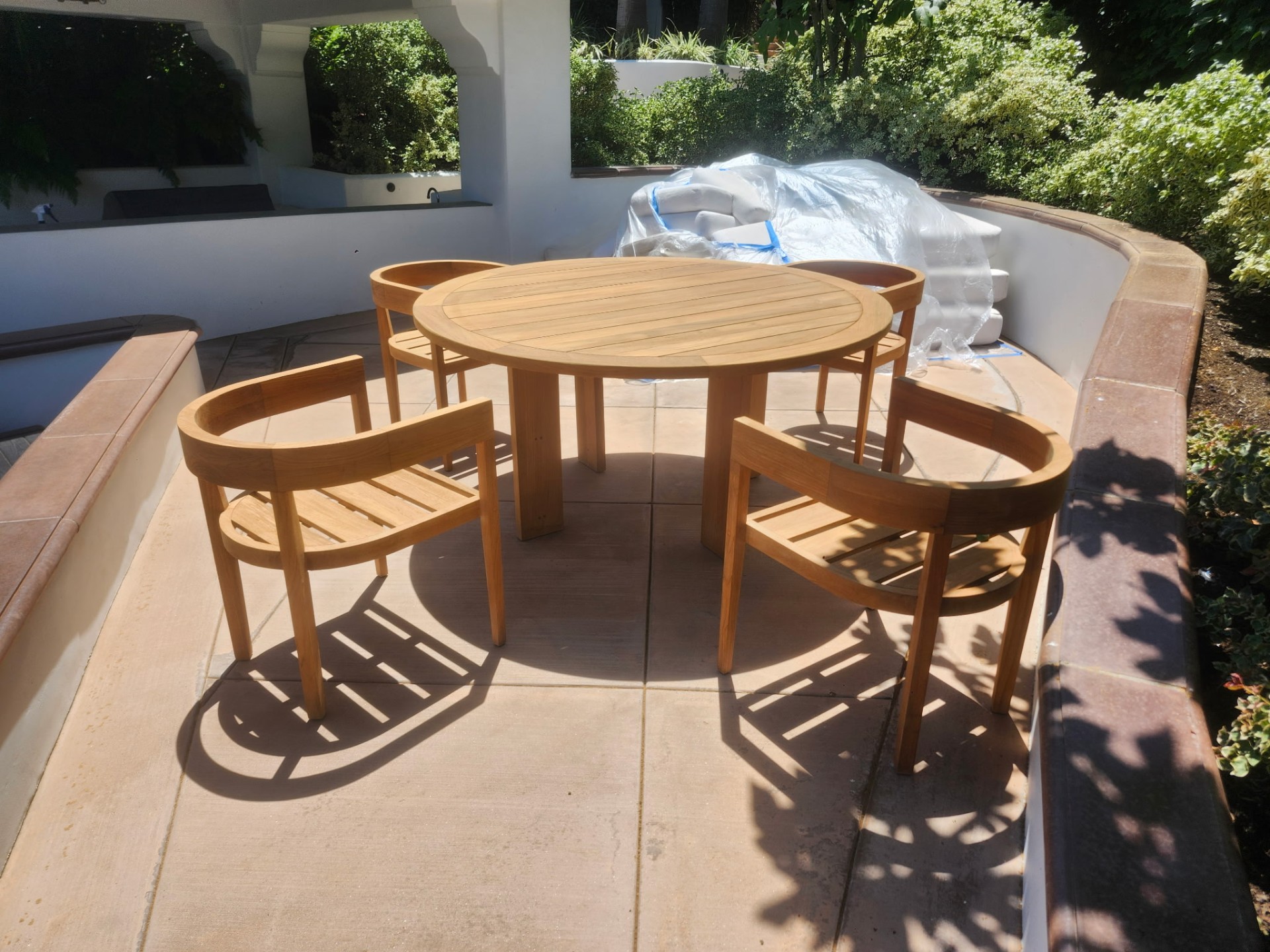
Outdoor furniture restoration for wood that is worth keeping
Weathered patio sets, loungers, benches and dining tables brought back to a sound, protected surface, with joinery repaired at the same time.
Good outdoor furniture is built from timber chosen to survive the weather. What fails is the finish on top of it, and after that the joints that carry the load. Both are repairable long after a set has stopped looking presentable.
The work varies by species. Dense hardwoods take finish sparingly and reward careful sanding. Softer woods like cedar and redwood need a gentle hand, because aggressive preparation removes far more material than intended. Mahogany holds colour beautifully but wants real protection to keep it.
We assess the structure first. If the frame is sound and the joints hold, restoration is almost always the better decision. Where it is not, we say so rather than putting a finish onto wood that cannot hold one.
Assessment
Deciding what a piece actually needs
Three checks answer most of it before anyone quotes anything.
Load the frame
Sit on it, push it, watch the joints. Movement means mechanical work, not just a finish.
Test with water
Beading means the surface is still protected. Immediate soak-in means bare, absorbent wood.
Look underneath
Feet, rails and undersides hold moisture and hide most of the real damage.
Check the thickness
Pieces restored several times can have slats too thin to sand again. That changes the approach.
Repairs
Joinery work as part of restoration
Loose mortise and tenon joints, split slats, corroded fixings and seats that flex under load are all common on furniture that has been outside for years. None of them are unusual and most are straightforward when the piece is already being worked on.
Doing repairs during a restoration is far cheaper than doing them separately later, because the disassembly, preparation and finishing all happen once instead of twice.
Result
What you should expect afterwards
A restored set should feel smooth rather than fuzzy, shed water rather than absorb it, sit square without rocking, and read as one consistent colour across every piece.
It should also come with a realistic maintenance interval. We would rather tell you a finish needs attention within a year in full sun than promise something that will not hold.
Outdoor furniture restoration near you
We travel across Orange County, Los Angeles County and San Diego County. These pages cover the local conditions in each area.
Guides on this subject
Restoration vs. Replacement of Outdoor Wood Furniture
The decision is structural first and financial second. Appearance should not drive it at all.
Can Severely Weathered Teak Be Restored?
Usually yes. The limiting factor is structure, not appearance.
How to Maintain Teak After Restoration
Freshly restored teak needs very little. What it needs, it needs consistently.
Common questions
Which woods can you restore?
Teak, ipe and other dense tropical hardwoods, mahogany and sapele, cedar and redwood, plus most hardwood used in quality outdoor furniture. Each needs a different preparation approach.
Is restoring cheaper than replacing?
On structurally sound furniture, almost always. Replacement also restarts the weathering cycle immediately at a much higher cost, so it rarely solves the underlying maintenance question.
Do you take furniture away?
Usually not. Working on site avoids transport risk and keeps large, heavy and built-in pieces where they belong.
Can you match pieces across a set?
Yes, and it is the main reason to restore a set together. Finishing pieces at different times is how sets end up mismatched.
What about cushions and hardware?
We handle the timber, joinery and finish, and re-seat or replace fixings where needed. Upholstery is not part of the service.
Tell us what needs restoring
A photo and a rough piece count is usually enough for us to come back with a realistic scope and price.
Browse every service area
On-site teak restoration and Ipe deck refinishing across Orange County, Los Angeles County and San Diego County. Every city we serve has its own page.