Marina del Rey Teak Restoration for Waterfront and Yacht Teak
Restoring teak patio furniture, dock boxes, and boat teak for residents and yacht owners throughout Marina del Rey's waterfront community.
Trusted across Marina del Rey by
Why Marina del Rey homeowners search for teak restoration near me
Searching locally is the right instinct. A restorer who works in Los Angeles County every week already knows what your exposure does to wood and how long a finish realistically lasts here.
Mobile service
Work happens at your Marina del Rey address. Nothing is crated, transported or held in a shop for weeks.
Free on-site estimates
In-person assessment, usually within a couple of days, with a written price before you commit to anything.
Climate knowledge
We know what salt air, marine layer and UV do to Marina del Rey teak, because we correct it constantly.
Veteran-owned
Founded and run by a US military veteran. Kept appointments, finished days, straight answers.
Regional coverage
Orange County, Los Angeles County and San Diego County, with the same crew and the same standard.
Local references
Homeowners, HOAs and hospitality clients across Los Angeles County we can point you to.
Teak Care for America's Largest Small-Craft Harbor
Marina del Rey is built almost entirely around water — condo balconies overlooking the main channel, townhomes backing directly onto private docks, and one of the largest concentrations of pleasure boats on the West Coast. Teak here takes a steady, near-constant dose of humid marine air that's different from the drier salt exposure found along more open coastline like Malibu or Palos Verdes.
Because so much of the marina's residential stock is condos and townhomes with small private balconies or patios, we do a lot of restoration work in tighter spaces than a typical single-family backyard, often coordinating with building management or HOAs for elevator access and loading dock scheduling.
Beyond furniture, we also service teak on boats themselves — cockpit decking, swim platforms, and cabin trim for members of the marina's yacht clubs, which requires a different set of techniques than patio furniture since boat teak has to withstand direct water contact and constant motion, not just weather.
The marina's channel creates a funnel effect for wind and moisture, so furniture facing the main channel or fairway can develop mildew and green algae staining faster than pieces set back on inland-facing patios, even within the same building.
We work with residents throughout the marina's neighborhoods — from the high-rises near Admiralty Way to the townhome clusters on the smaller finger docks — as well as boat owners docked at the marina's various yacht clubs and private slips.
We coordinate with condo and townhome HOAs throughout Marina del Rey for elevator and loading access, and we service boat-mounted teak for yacht club members at the marina's private slips.
Neighborhoods we regularly service in Marina del Rey
- Silver Strand
- Peninsula
- Marina Peninsula
- Villa Marina
- Marina Harbor
- Dock 52
- Basin C
- Basin H
The marine layer and why Marina del Rey teak stays damp
Morning fog is the single most underrated influence on outdoor wood here. Overnight condensation wets every horizontal surface in Marina del Rey, and afternoon sun then drives that moisture back out. The wood swells and shrinks slightly each day.
That daily cycle is what raises grain and eventually opens the hairline checks people notice along tabletops. It also keeps shaded joints damp long enough for mildew to establish, which is why the black spotting we treat is usually on north-facing faces and slat undersides rather than in the sun.
Finishes that flex and breathe handle this better than hard films. A penetrating oil moves with the wood; a brittle surface film cracks and lets water underneath, which is the failure mode we see most often on coastal properties.
Other teak and hardwood we finish in Marina del Rey
Furniture is most of the work but rarely all of it. These are the fixed and functional pieces we are asked to bring in line with a restored set.
Built-in benches
Restored in place with surrounding stone, render and planting fully masked before any sanding starts.
Gates and side doors
Vertical exterior joinery where the finish fails first at the top rail and the bottom edge.
Outdoor shower and spa teak
Constant wetting demands a different specification from anything on a dry terrace.
Pergolas and rafter tails
High, awkward and rarely maintained, which is why they are usually the greyest wood on a property.
Yacht and dock teak
Cockpit tables, rails, swim platforms and trim finished to marine standards in the slip.
Hardwood decking
Teak, ipe and mahogany decks across Marina del Rey, cleaned, flattened and re-oiled to match the furniture on them.
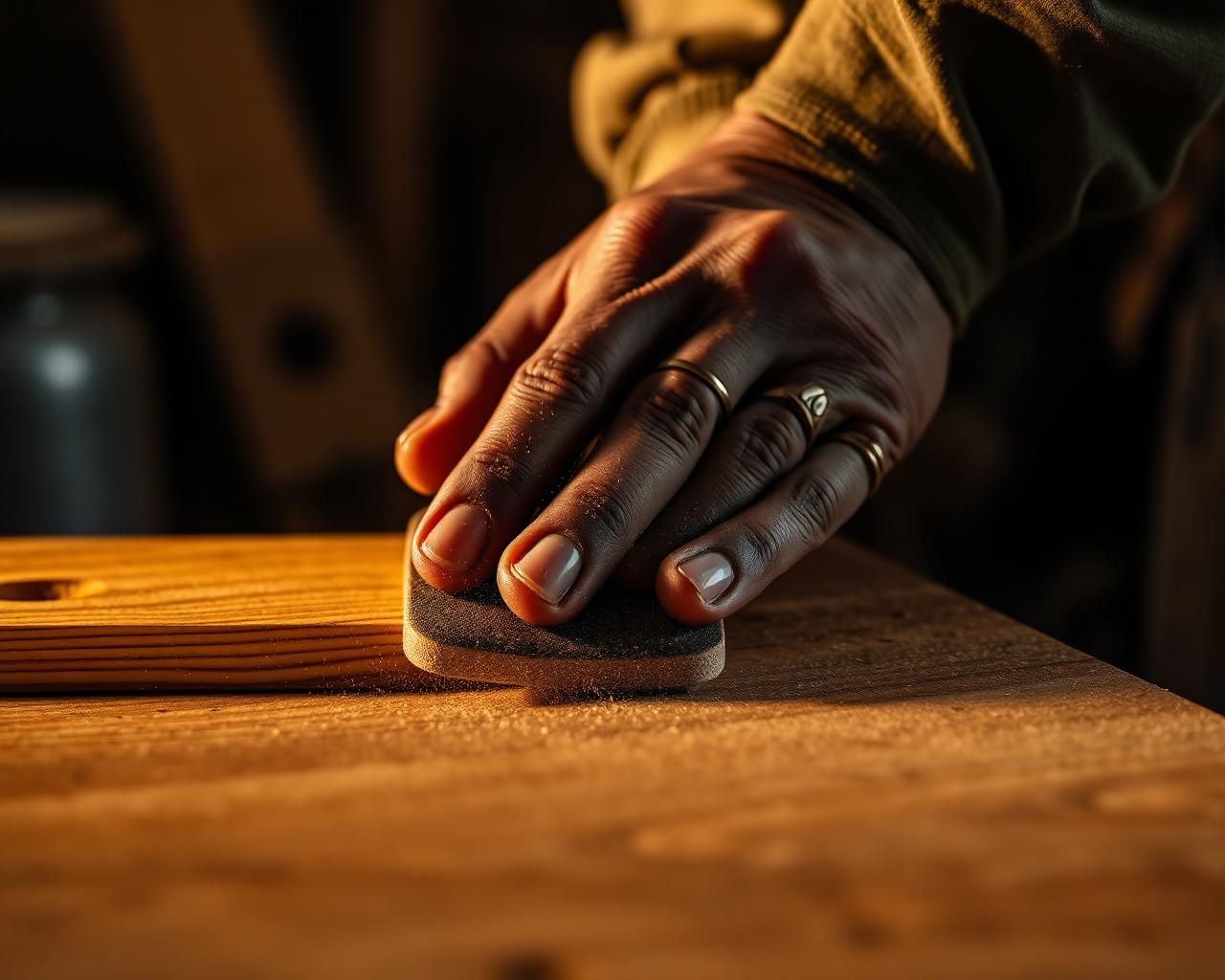
Hand-finished
Every grain inspected, sanded and sealed by a master craftsman.
From first call to finished patio.
- 01
The call
A few photos and a description usually tell us the likely scope and rough range before we ever visit.
- 02
Free estimate visit
Thirty minutes on site. Piece count, condition grade, finish options and a fixed written price.
- 03
Disassembly where needed
Slatted loungers and folding chairs are opened up so the hidden faces get the same treatment as the visible ones.
- 04
Clean, neutralise, dry
The wood has to be genuinely dry before finish goes on. Oil over trapped moisture clouds and lifts.
- 05
Build the protection
Thin coats, wiped back, repeated. Depth comes from the number of coats, never from the thickness of one.
- 06
Handover
Reassembly, a final wipe down, and a walkthrough of what to watch over the next twelve months.
Oil, sealer or natural silver
There is no single best finish for teak, only the best finish for a piece, an exposure and an appetite for maintenance.
Penetrating oil
Richest colour, sits in the wood rather than on it, so it can never peel. Shortest refresh interval.
Protective sealer
A light protective layer with UV inhibitors. Longer service life, slightly less depth of grain.
Natural weathering
Cleaned, sanded, left bare to silver evenly and deliberately. Lowest maintenance and architecturally valid.
Restored teak across Marina del Rey's finest properties and yachts.
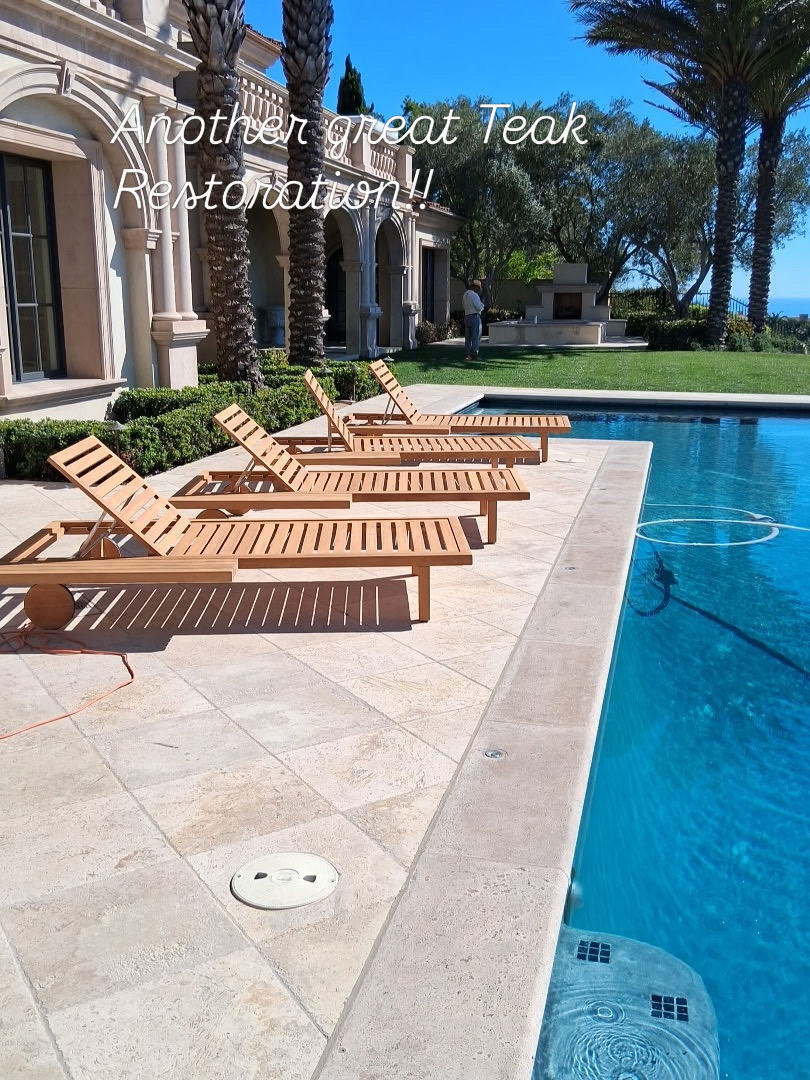
Sets, loungers, tables and built-ins finished on the client's own terrace. Tap to open any image full size.
Hilltop Patio Set
Newport Beach, CA
Estate Dining Table for Eight
Newport Coast, CA
Additional restorations nearby
Teak restoration in Marina del Rey — answers to the questions we hear most.
Proudly serving Marina del Rey & the Westside.
On-site teak restoration, yacht decking refinishing and outdoor furniture restoration throughout Marina del Rey and every neighboring Westside community.
- Marina del Rey
- Newport Beach
- Corona del Mar
- Newport Coast
- Laguna Beach
- Costa Mesa
- Huntington Beach
- Irvine
- Tustin
- Orange
- Villa Park
- Yorba Linda
- Aliso Viejo
- Lake Forest
Teak restoration near Marina del Rey
We work throughout the communities surrounding Marina del Rey, often on the same trip.
More ways we serve Marina del Rey
Worth reading before you book
Ipe Deck Maintenance Guide
Ipe is dense enough to survive almost anything. Keeping it brown rather than silver is the part that takes a routine.
Read guideHow Coastal Weather Affects Teak Furniture
Near the ocean, three separate forces act on outdoor wood at once. Understanding which one is doing the damage changes how you maintain it.
Read guideHow to Restore Weathered Teak Furniture
Grey teak is almost always surface oxidation, not damage. Here is the full sequence used to bring it back, and the points where the job usually goes wrong.
Read guideTalk to a restorer about your Marina del Rey project
Tell us what you have and how it is used. We will tell you what it needs and what it will cost.
Tell us about your Marina del Rey teak project.
Tell us what you have, how it is used and roughly how long since it was last finished. That is enough for a realistic range.